
Witness Protection, Concealed Histories, and Protected Identities.
My father disappeared into Witness Protection in 1972.
I was five years old. I never saw him again.
My father disappeared into Witness Protection in 1972.
I was five years old. I never saw him again.

The Glomar Response: We Can Neither Confirm Nor Deny began with a question Mark Babcock had spent decades trying not to revisit too closely: what happened to the father who disappeared from his life in 1972 when he was five years old?
For years the question remained unanswered, surfacing only occasionally beneath the routines of adulthood. The search began in earnest later in life after a close friend's cancer diagnosis forced him to confront the possibility that whatever remained hidden about his father might eventually disappear along with the people and records still connected to it.
At first, the effort resembled many family history investigations: genealogy websites, public records, archived reporting, military records, and the possibility that someone might still remember the man who had vanished from his life decades earlier.
The investigation changed course shortly after Babcock contacted his father's brother-in-law. During that conversation, he learned that the family who disappeared from his life in 1972 had spent decades living under different names, identities, and histories associated with Witness Security.
He also learned something else. His father had died by suicide in 1993 after years of living through multiple identities, conflicting histories, and circumstances he was only beginning to understand.
Developed through years of archival research, government records requests, court filings, military records, and federal and state archives, The Glomar Response documents an effort to reconstruct not only the life of a father who disappeared, but the institutional systems, records structures, and documentary history that surrounded that disappearance long after it occurred.
Responsive To Your Request begins where The Glomar Response leaves off.
After years spent locating records, the search increasingly became an effort to understand where records had been, who had handled them, and what remained after decades of transfers, referrals, redactions, archival storage, records destruction, and agency reorganization.
Documents that initially appeared unrelated often connected to one another through distribution lists, routing information, archived correspondence, referrals, and references preserved inside entirely different records systems. A name appearing in one file could lead to an index maintained by another agency. A referral letter could reveal where records had been transferred decades earlier. Even a denial sometimes revealed where information had once existed and who had been responsible for maintaining it.
As the records accumulated, the investigation increasingly focused on the relationships between them. Individual files rarely answered larger questions by themselves. Meaning often emerged only after records from different agencies, jurisdictions, and time periods were assembled alongside one another.
Developed through decades of records requests, archival research, court filings, military records, and agency correspondence, Responsive To Your Request documents the continuing effort to understand how records move through institutions, how documentary continuity survives administrative change, and how historical narratives can sometimes be reconstructed through the relationships between records preserved by different agencies across time.
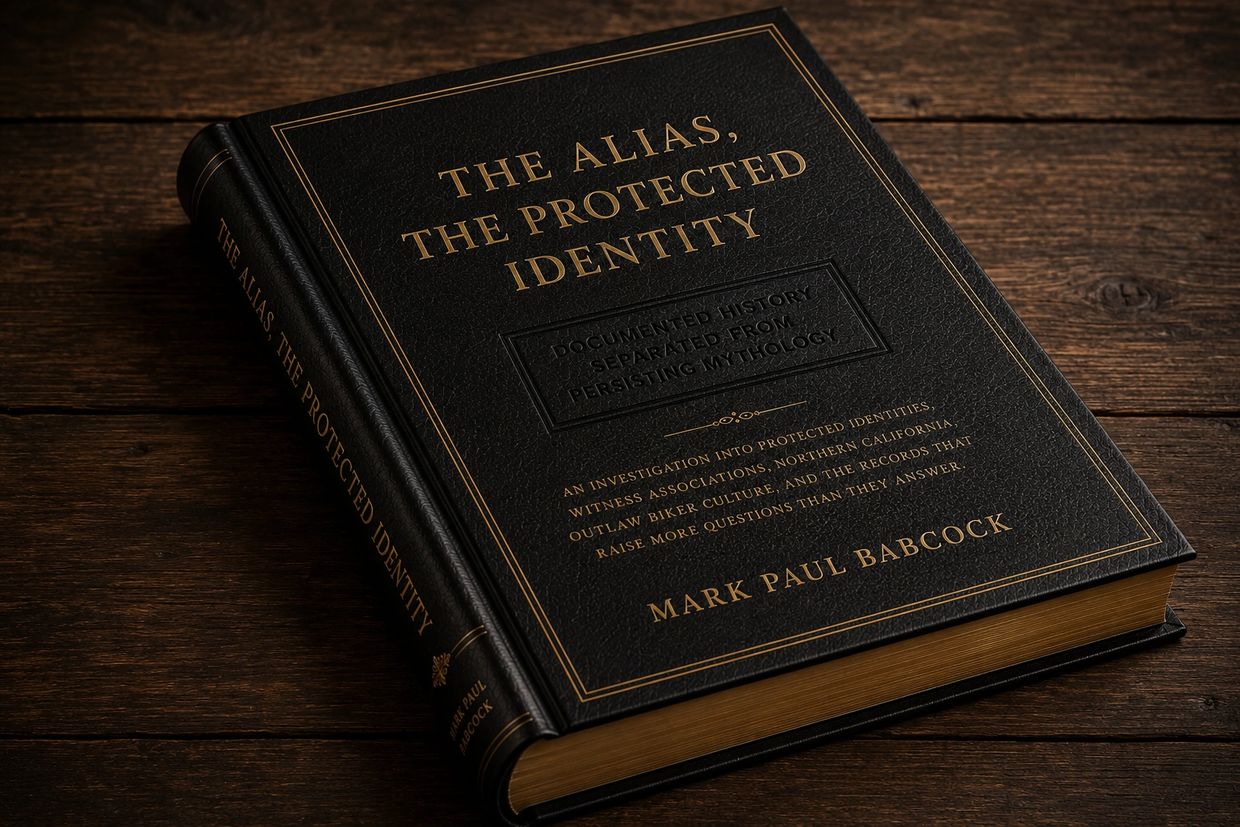
The Alias, The Protected Identity emerged from the investigation documented in The Glomar Response. As additional records surfaced, the search increasingly encountered a second problem: separating documented history from the mythology that had accumulated around it over decades.
The project examines the unusual intersection between protected identities, witness associations, Northern California history, outlaw biker culture, and a body of surviving records that repeatedly produced questions no single source could fully answer. Some elements can be documented. Others remain impossible to verify. Between them exists a space where historical fact, personal memory, public mythology, and institutional secrecy often become difficult to separate.
What made those questions difficult to dismiss was not simply the documentary record itself. Long before any possible connection to his father was ever suggested, Mark Babcock had spent decades as a motorcycle rider and more than fifteen years working professionally within the motorcycle industry. Many of the people, places, stories, and cultural references that later surfaced during the investigation were already familiar to him long before they appeared alongside records connected to his own family history.
Rather than attempting to prove mythology as fact, The Alias, The Protected Identity documents the effort to understand why certain stories persisted, where they originated, what documentary evidence exists, and why some possibilities can seem impossible from one angle and strangely believable from another.
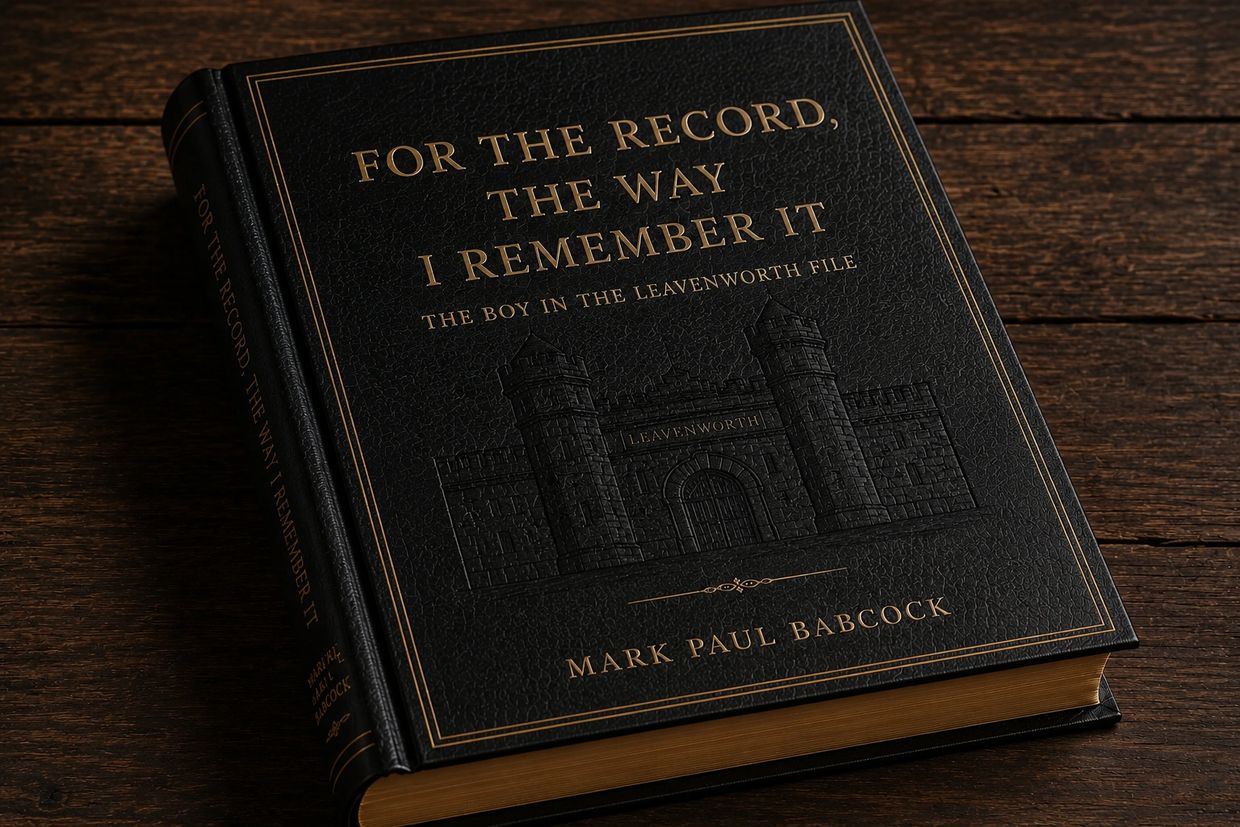
For The Record, The Way I Remember It began after Mark Babcock discovered that his grandfather, a quiet family man he had known his entire life, had once been a seventeen-year-old Chicago teenager sent to Leavenworth in 1928 following an automobile theft committed shortly after the death of his mother.
What emerged from the surviving records was not simply the history of a federal prison sentence, but a documentary record preserved across nearly a century through intake forms, parole documents, fingerprint cards, telegrams, correspondence, federal memoranda, and other surviving records. As the records accumulated, the project developed around a simple premise: what if his grandfather could sit beside him and explain what the documents got right, what they got wrong, and what they failed to capture altogether?
Rather than focusing solely on incarceration, For The Record examines the relationship between institutional records, family memory, and lived experience. The narrative follows the reconstruction of a seventeen-year-old inmate whose later life would be defined not by Leavenworth, but by marriage, work, military service, family, and the decades that followed.
Told through surviving records and family recollections, the project explores the distance between what institutions documented and what the people who lived those events actually remembered.
Years of records requests eventually revealed that many of the obstacles encountered during this search were not unique.
Significant portions of personal history sometimes survive only within government records dispersed across multiple agencies, identities, jurisdictions, and decades of recordkeeping.
The Family Access and Records Reform Initiative emerged through years of records requests, archival research, and documentary reconstruction that revealed how difficult lawful historical access can become when records are divided among multiple agencies, transferred between systems, restricted by different authorities, or associated with identities family members never knew existed.
Often, these challenges do not become visible until a death, disappearance, protected identity, incarceration, military service, or other government involvement has already altered the surviving documentary record.
As the research expanded, it became increasingly clear that many families inherit unanswered questions without any clear process for determining what happened, where records exist, what records no longer exist, or which agencies may still maintain information relevant to their family history.
The consequences often extend beyond genealogy. Families may encounter challenges involving veterans records, educational records, healthcare systems, retirement benefits, inheritance matters, disability programs, and other forms of lawful identity verification that depend upon accurate historical documentation.
The initiative does not argue that witness protection, protected identities, classified programs, or other sensitive government systems are inherently improper.
Instead, it asks a narrower question:
What responsibilities, if any, do institutions have to surviving family members when government records contain the only remaining pathway to understanding significant portions of their own history?
In many cases, the individuals most directly affected possess only partial understanding of the investigations, administrative actions, records decisions, or government programs that shaped their documentary history.
The initiative therefore examines whether existing archival review procedures, next-of-kin access policies, and records disclosure frameworks adequately address unresolved historical questions after the events themselves have passed into history.
The question is not whether sensitive systems should exist.
The question is whether families should have any meaningful opportunity to understand portions of their own history when government records remain the only surviving source of documentary continuity.
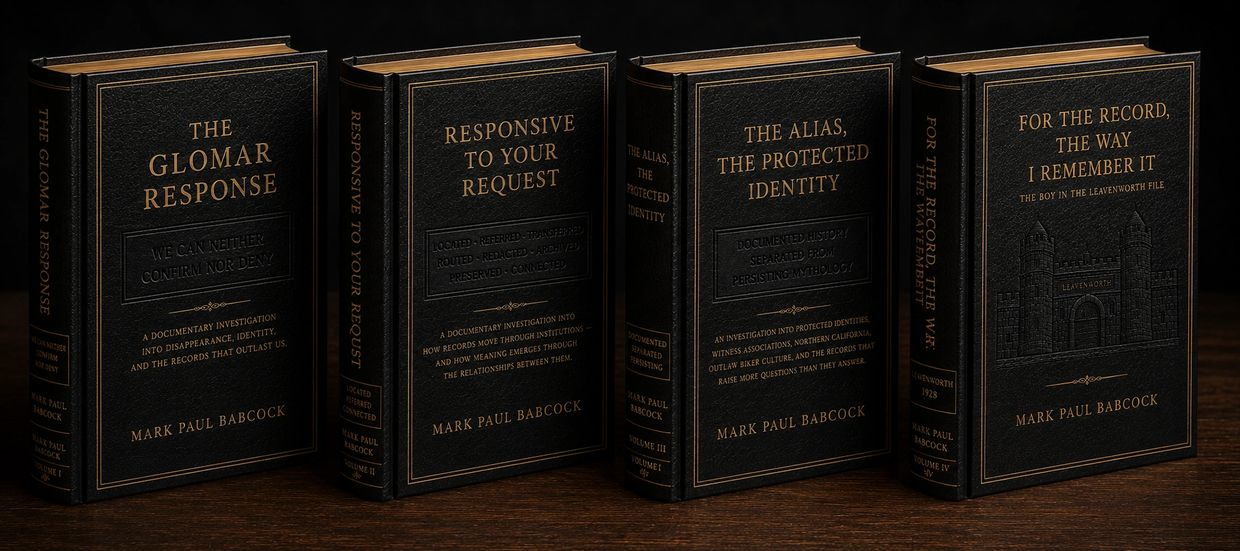
What began as a search for answers about a missing father eventually became a decades-long documentary investigation into records, identity, and historical continuity.
Mark Babcock is a documentary author and independent investigator whose work focuses on government records, protected identities, witness security, archival access, and documentary reconstruction.
His research began in 2008 during an effort to better understand the disappearance of his father, who vanished from his life in 1972. Over time, that search expanded into a broader examination of how personal history survives within government records systems and institutional archives.
Since 2008, Babcock has conducted long-term records research involving federal and state archives, court filings, military records, agency correspondence, public records requests, and historical collections spanning multiple decades.
His work examines how records survive, transfer, disappear, conflict, and occasionally reconnect across institutions, jurisdictions, and generations. Particular attention is given to the challenges families encounter when attempting to reconstruct historical events through surviving documentation and to the ways significant portions of personal history can remain preserved only within institutional records.
Babcock's documentary projects include The Glomar Response, Responsive To Your Request, The Alias, The Protected Identity, For The Record, The Way I Remember It, and the Family Access and Records Reform Initiative.
Through writing, documentary projects, media participation, public presentations, and the publication of historical records and research findings, the work also seeks to increase public awareness of records access, documentary continuity, protected identities, and the long-term challenges that can emerge when historical understanding depends upon records maintained across multiple institutions and generations.